
Routine
Toner, Essence, Serum, and Ampoule Shopping Map
Map toner, essence, serum, and ampoule by exact texture, formula, directions, and routine job so a K-beauty leave-on routine stays small and non-duplicative.
- Best for
- K-beauty shoppers confused by overlapping toner, essence, serum, and ampoule names and deciding whether any optional leave-on step is needed
- Shopping context
- a middle-of-routine mapping task where product labels do not reliably indicate viscosity, concentration, order, strength, or necessity across brands
Updated 2026-07-22 · 9 min read
Answer first
How do toner, essence, serum, and ampoule differ in a routine?
Treat toner, essence, serum, and ampoule as optional leave-on lanes, not four required steps. Compare the exact texture, formula, directions, and missing routine job because product names do not consistently establish thickness, concentration, strength, order, or necessity across brands.
Key decisions
- Define the exact job behind toner essence serum ampoule before opening product, store, or provider options.
- Keep candidates inside the same job and compare current directions, format, version, and source evidence.
- Record one next action and leave unresolved price, stock, rating, availability, or service details for a current check.
On this page
- Answer in brief
- The short answer
- What should decide the answer
- A practical workflow
- How to compare alternatives
- Mistakes that weaken the decision
- Build a routine-change record
- Verification and next step
- Decision asset
- Decision table
- Common mistakes
- Source prompts
- Source boundaries
- Current checks
- Sources
- Related search answers
- Quick answers
The short answer
Treat all four labels as optional product lanes, identify one missing job, and let the exact texture and directions decide placement instead of a fixed four-step order In “Toner, Essence, Serum, and Ampoule Shopping Map,” the guide is designed for k-beauty shoppers confused by overlapping toner, essence, serum, and ampoule names and deciding whether any optional leave-on step is needed. The practical context is a middle-of-routine mapping task where product labels do not reliably indicate viscosity, concentration, order, strength, or necessity across brands. The goal is to leave with one clear next step, not a longer list of products, techniques, or places to research.
What should decide the answer
For “Toner, Essence, Serum, and Ampoule Shopping Map,” use these factors in order instead of starting with a viral product, a promotion, or a single featured ingredient. 1) Toner, essence, serum, and ampoule are not globally standardized levels of thickness, concentration, strength, or performance. 2) Watery, milky, lotion-like, gel, oil-like, viscous, pad, mist, and active-style formats can cross the category boundaries. 3) The complete current formula, application directions, warnings, package, and version matter more than the largest ingredient word on the front. 4) Several products may repeat hydration, slip, occlusion, featured-ingredient, or active-style roles even when their category names differ. 5) Order should follow exact product directions and practical texture behavior, while moisturizer and morning sunscreen remain clearer anchor steps. If two options still look equal, prefer the one with clearer current directions and fewer unresolved questions.
A practical workflow
Work through “Toner, Essence, Serum, and Ampoule Shopping Map” as a sequence rather than collecting disconnected tips. 1) List every current leave-on product and label its actual job, texture, time of day, and current directions. 2) Write the one missing job and select toner, essence, serum, ampoule, or no product only after that sentence is clear. 3) Save exact candidates with formula source, directions, version, package, texture lane, and any active-style handling question. 4) Remove candidates that duplicate another leave-on step, moisturizer, sunscreen, or occasional product in the same routine. 5) Add one selected layer according to its label and update the map before considering another optional category. Save the result in plain language so the next store visit, application attempt, or online check starts from a documented decision.
Toner, Essence, Serum, and Ampoule Shopping Map: decision checklist
Use this guide-specific checklist to turn the article into one documented next decision.
- List every current leave-on product and label its actual job, texture, time of day, and current directions.
- Write the one missing job and select toner, essence, serum, ampoule, or no product only after that sentence is clear.
- Save exact candidates with formula source, directions, version, package, texture lane, and any active-style handling question.
- Remove candidates that duplicate another leave-on step, moisturizer, sunscreen, or occasional product in the same routine.
- Add one selected layer according to its label and update the map before considering another optional category.
How to compare alternatives
Within the decision covered by “Toner, Essence, Serum, and Ampoule Shopping Map,” keep alternatives inside the same job before comparing them. Reuse the decision factors—Toner, essence, serum, and ampoule are not globally standardized levels of thickness, concentration, strength, or performance., Watery, milky, lotion-like, gel, oil-like, viscous, pad, mist, and active-style formats can cross the category boundaries., The complete current formula, application directions, warnings, package, and version matter more than the largest ingredient word on the front., Several products may repeat hydration, slip, occlusion, featured-ingredient, or active-style roles even when their category names differ.—and mark each field as confirmed, preference-dependent, or still unknown. A difference only matters when it changes comfort, application, routine fit, travel handling, or the ability to verify the current source.
Mistakes that weaken the decision
In “Toner, Essence, Serum, and Ampoule Shopping Map,” avoid shortcuts that make the page or purchase look more certain than the evidence allows. 1) Treating toner, essence, serum, and ampoule as four mandatory consecutive steps. 2) Assuming ampoule is always strongest, serum always most targeted, essence always medium, or toner always thinnest. 3) Buying several hydration-positioned or active-style products because each uses a different category name. 4) Setting a universal order without checking the exact product directions, texture, and surrounding moisturizer or sunscreen. Treat an unanswered question as a reason to pause, not as permission to fill the gap with assumptions.
Build a routine-change record
For this routine-change record, the working answer to “Toner, Essence, Serum, and Ampoule Shopping Map” is: Treat all four labels as optional product lanes, identify one missing job, and let the exact texture and directions decide placement instead of a fixed four-step order This record is intended for K-beauty shoppers confused by overlapping toner, essence, serum, and ampoule names and deciding whether any optional leave-on step is needed. In the context “a middle-of-routine mapping task where product labels do not reliably indicate viscosity, concentration, order, strength, or necessity across brands,” compare “Toner, essence, serum, and ampoule are not globally standardized levels of thickness, concentration, strength, or performance” with “Watery, milky, lotion-like, gel, oil-like, viscous, pad, mist, and active-style formats can cross the category boundaries” and mark each field as confirmed, preference-dependent, or unresolved. Connect “The complete current formula, application directions, warnings, package, and version matter more than the largest ingredient word on the front” to the action “List every current leave-on product and label its actual job, texture, time of day, and current directions” only when the evidence supports both. Treat “Treating toner, essence, serum, and ampoule as four mandatory consecutive steps” as a stop condition while “Several products may repeat hydration, slip, occlusion, featured-ingredient, or active-style roles even when their category names differ” remains unclear, and return to “List every current leave-on product and label its actual job, texture, time of day, and current directions” before proceeding. Before closing the record, answer “What one leave-on job is not already handled by the current routine” within the boundary “FDA cosmetics resources provide general U.S. label and ingredient context and do not standardize Korean leave-on category names” and attach the source that controls “Toner, essence, serum, and ampoule are not globally standardized levels of thickness, concentration, strength, or performance” for K-beauty shoppers confused by overlapping toner, essence, serum, and ampoule names and deciding whether any optional leave-on step is needed. For a useful handoff, pair “What exact texture, formula, directions, warnings, version, and package does each candidate have” with “Write the one missing job and select toner, essence, serum, ampoule, or no product only after that sentence is clear” while preserving “Watery, milky, lotion-like, gel, oil-like, viscous, pad, mist, and active-style formats can cross the category boundaries” for K-beauty shoppers confused by overlapping toner, essence, serum, and ampoule names and deciding whether any optional leave-on step is needed, so the next reader can see why the option was used, compared later, or skipped. When the record is reopened, answer “Which candidates repeat hydration, slip, featured-ingredient, active-style, or final-step roles” before repeating “Assuming ampoule is always strongest, serum always most targeted, essence always medium, or toner always thinnest,” and compare the new evidence with this page-specific scope: “Map toner, essence, serum, and ampoule by exact texture, formula, directions, and routine job so a K-beauty leave-on routine stays small and non-duplicative.”
Verification and next step
Before acting on “Toner, Essence, Serum, and Ampoule Shopping Map,” run a final source pass. 1) What one leave-on job is not already handled by the current routine? 2) What exact texture, formula, directions, warnings, version, and package does each candidate have? 3) Which candidates repeat hydration, slip, featured-ingredient, active-style, or final-step roles? 4) Does the proposed order follow current directions and make practical sense with moisturizer and sunscreen? 5) Would one product or no new product produce a clearer routine than a category-complete set? The evidence boundary for this guide is: 1) FDA cosmetics resources provide general U.S. label and ingredient context and do not standardize Korean leave-on category names. 2) Category, texture, and featured ingredients do not establish concentration, performance, necessity, or individual suitability. 3) Current manufacturer directions take precedence over generic K-beauty step charts and category hierarchies. 4) This guide supports cosmetic routine mapping and does not diagnose or treat a skin condition. When a current label, provider page, retailer listing, or official travel source disagrees with saved notes, use the current source and update the notes. Record the source, access date, exact product or provider, and unresolved field so the decision can be audited later.
Common mistakes to avoid
- Treating toner, essence, serum, and ampoule as four mandatory consecutive steps.
- Assuming ampoule is always strongest, serum always most targeted, essence always medium, or toner always thinnest.
- Buying several hydration-positioned or active-style products because each uses a different category name.
- Setting a universal order without checking the exact product directions, texture, and surrounding moisturizer or sunscreen.
Source verification prompts
- What one leave-on job is not already handled by the current routine?
- What exact texture, formula, directions, warnings, version, and package does each candidate have?
- Which candidates repeat hydration, slip, featured-ingredient, active-style, or final-step roles?
- Does the proposed order follow current directions and make practical sense with moisturizer and sunscreen?
- Would one product or no new product produce a clearer routine than a category-complete set?
Source boundaries
- FDA cosmetics resources provide general U.S. label and ingredient context and do not standardize Korean leave-on category names.
- Category, texture, and featured ingredients do not establish concentration, performance, necessity, or individual suitability.
- Current manufacturer directions take precedence over generic K-beauty step charts and category hierarchies.
- This guide supports cosmetic routine mapping and does not diagnose or treat a skin condition.
Verify current details
- Verify the current first-party, official, government, label, or retailer source that controls toner essence serum ampoule.
- Match the exact product, version, directions, seller or provider, date, and changing terms before acting.
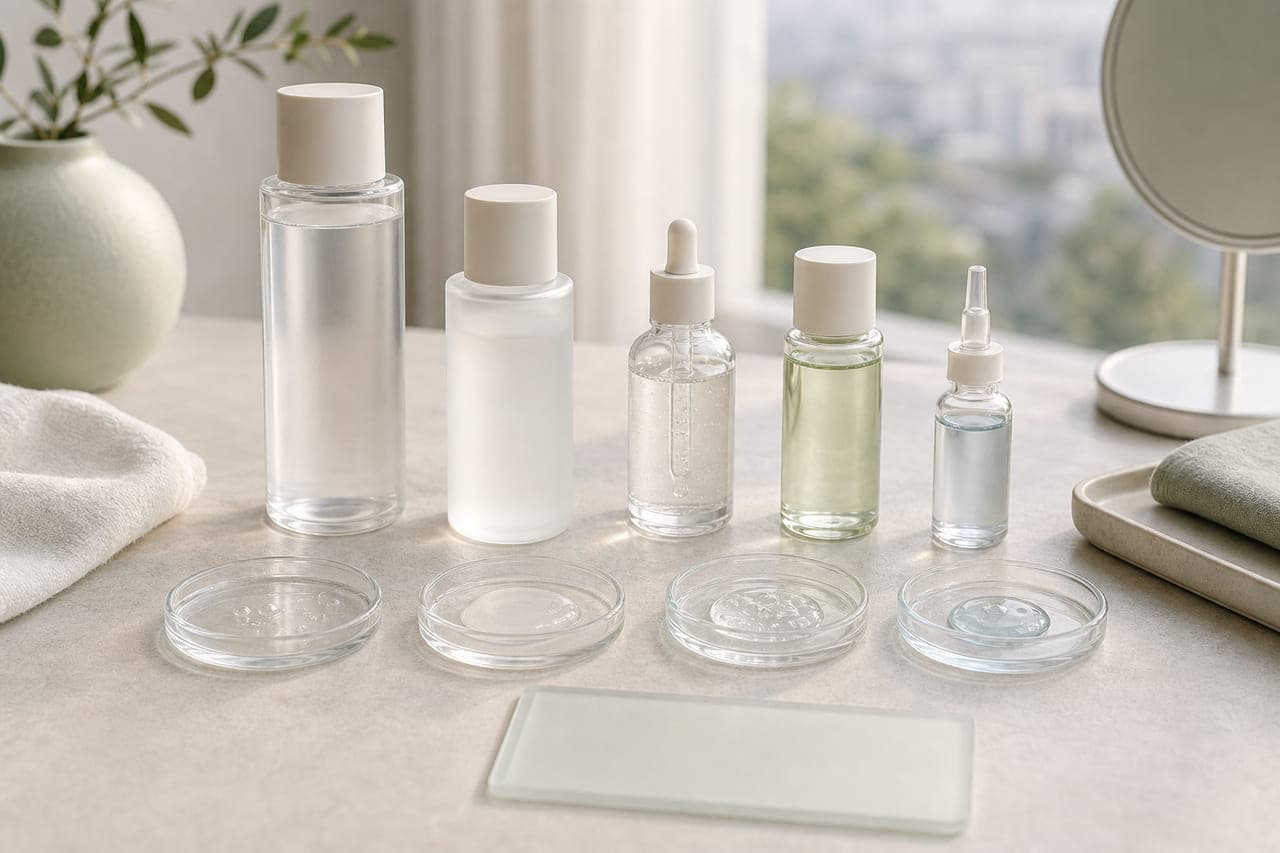
Toner, essence, serum, and ampoule role map
Map exact leave-on products by directions, texture, application, and actual routine job without treating category names as required potency levels.
| Research stage | Decision action | Evidence boundary |
|---|---|---|
| Exact identity | Record full product name, format wording, rinse or leave-on status, application area, frequency, warnings, and current directions. | The category word does not establish concentration, potency, molecular size, absorption, efficacy, or order. |
| Routine job | Write the single job each exact product adds and compare it with moisturizer, mist, pad, mask, or other leave-ons already used. | Different names can still describe overlapping jobs, and a four-category map does not require four products. |
| Layer behavior | Compare amount, spread, finish, wait time, and interaction under moisturizer, sunscreen, or makeup with stable surrounding products. | A thinner texture does not prove earlier order, better absorption, greater need, or universal compatibility. |
| Smallest useful set | Choose one product for the missing job, separate distinct contexts, compare later, or keep none of the optional formats. | The map cannot rank categories, guarantee performance, or prescribe a fixed Korean skincare step count. |
Toner, essence, serum, and ampoule names are not standardized performance or concentration tiers. Verify each exact current label and formula.
Editorial decision brief
Separate watery leave-on layers without adding duplicate routine steps.
Choose the missing routine role first. Toner, essence, serum, and ampoule labels can overlap, so texture and directions matter as much as the category name.
Decision output
A leave-on-layer decision map that narrows the next research step to one role or comparison lane.
Source checks for this page
- Check whether the current label positions the product as toner, essence, serum, ampoule, or another leave-on layer.
- Compare texture, use directions, and active-style ingredient context before adding another layer.
- Confirm current seller and return details only on the source page; this guide does not publish live commercial terms.
Editorial refresh reviewed 2026-06-24
Continue this research path
Evidence trail
Sources
- U.S. FDA cosmetics labeling resources
government
- U.S. FDA cosmetic ingredients overview
government
Continue the research path
Routines
Browse routine guides
Continue with step order, weather, travel, and makeup-prep routine maps.
Scorecard
Score the shortlist
Compare role, texture, label details, seller checks, travel fit, and final decision.
Shortlist
Save a smaller shortlist
Keep product candidates and verification notes in this browser while comparing options.
Retailer check
Verify the retailer page
Use seller, label, version, shipping, and return checks before relying on a retailer listing.
Routine
Check routine fit
Map skin type, category, and routine role before adding another product step.
Quick answers
How do toner, essence, serum, and ampoule differ in a routine?
Treat toner, essence, serum, and ampoule as optional leave-on lanes, not four required steps. Compare the exact texture, formula, directions, and missing routine job because product names do not consistently establish thickness, concentration, strength, order, or necessity across brands.
What is the first decision for toner essence serum ampoule?
Write the exact job, constraint, and existing alternative first. This keeps the research question smaller than a general product, store, or trend search.
Which details must be verified for toner essence serum ampoule?
Verify the exact identity, current directions, version, source date, and the seller, provider, travel, or checkout details that can change.
Does toner essence serum ampoule provide a universal winner or live commercial data?
No. The guide provides an educational decision framework and does not invent a universal winner, live price, stock, rating, review count, promotion, or availability.
What is the quickest way to use Toner, Essence, Serum, and Ampoule Shopping Map?
Treat all four labels as optional product lanes, identify one missing job, and let the exact texture and directions decide placement instead of a fixed four-step order Start with the four decision factors, complete the workflow once, and keep unresolved source details in a compare-later note.
Does Toner, Essence, Serum, and Ampoule Shopping Map provide live prices, rankings, or availability?
No. It does not infer prices, ratings, review counts, stock, promotions, certifications, or availability. Check current official and retailer sources before acting.
Related product profiles
Heartleaf 77 Soothing Toner
AnuaVerify the current Toner identity, label, and source status before deciding.
Heartleaf Extract + Panthenol
Advanced Snail 96 Mucin Power Essence
COSRXVerify the current Essence identity, label, and source status before deciding.
Snail Secretion Filtrate + Sodium Hyaluronate
DIVE-IN Low Molecular Hyaluronic Acid Serum
TorridenVerify the current Serum identity, label, and source status before deciding.
Hyaluronic Acid + Panthenol
Madagascar Centella Ampoule
SKIN1004Verify the current Serum identity, label, and source status before deciding.
Centella Asiatica Extract