
Routine
Korean Skincare Routine for Beginners: A Simple Order
A plain-English morning and night order for building a simple K-beauty routine, choosing optional steps, and avoiding duplicate products.
Updated 2026-07-22 · 8 min read
Answer first
What is a simple Korean skincare routine for beginners?
A simple beginner routine can begin with gentle cleansing, moisturizer when needed, and sunscreen as the final morning skincare step. A toner, essence, or serum is optional and should be added one at a time only when it fills a clear role that the basic routine does not already cover.
Key decisions
- Choose the morning and night essentials before researching optional layers.
- Add one product at a time so texture, comfort, and routine overlap are easier to observe.
- Use current label directions to place each product instead of assuming every Korean routine needs many steps.
On this page
- Answer in brief
- Start with the essentials
- Add one new product at a time
- Keep sunscreen separate
- Build the routine by job, not step count
- Use a simple morning and night order
- Introduce changes one at a time
- Know when the routine is complete
- Shop the essential roles without building a haul
- Adjust texture without changing the routine map
- Keep occasional products outside the daily core
- Create a one-page beginner routine record
- Decision asset
- Routine length
- Source prompts
- Source boundaries
- Current checks
- Sources
- Related search answers
- Quick answers
Start with the essentials
A beginner routine can stay simple: use a gentle cleanse, moisturizer, and sunscreen as the final morning skincare step. Toner, essence, serum, and other leave-on layers are optional and should be added only when they fill a clear role.
Add one new product at a time
Introduce products slowly so it is easier to understand what feels comfortable. Patch testing is especially helpful for reactive or sensitive skin.
Keep sunscreen separate
Sunscreen is a morning step and should be chosen based on texture, comfort, and verified label information.
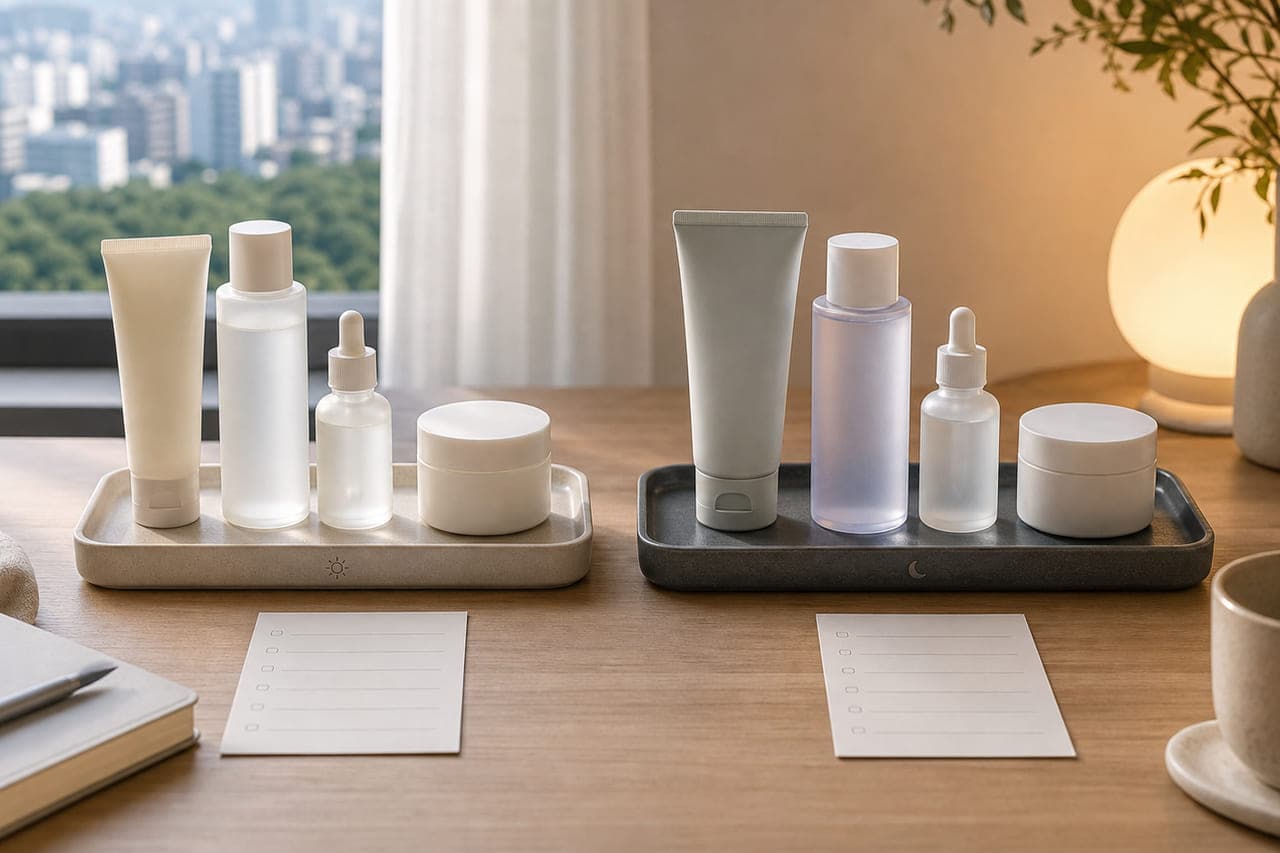
Simple Korean skincare routine order
Use this as a small starting map, then let the current directions for each exact product control placement and use.
| Order | Morning | Night | Beginner decision rule |
|---|---|---|---|
| 1 | Cleanse when needed | Cleanse | Use the exact cleanser directions and the day's makeup or sunscreen context; do not add a second cleanser only to increase the step count. |
| 2 | Optional toner, essence, or serum | Optional toner, essence, or serum | Begin with no more than one optional leave-on layer, and keep it only when it fills a role the basic routine does not already cover. |
| 3 | Moisturizer when needed | Moisturizer | Judge moisturizer inside the complete layer stack, because the sunscreen or optional leave-on product may change how much another layer contributes. |
| 4 | Sunscreen | No matching night step | Keep sunscreen as the final morning skincare step and follow the exact current label for application and reapplication directions. |
This table organizes cosmetic routine roles for education. It is not a diagnosis or treatment plan, and it does not make optional products necessary.
Build the routine by job, not step count
Start by naming the jobs the routine must cover. Cleansing removes the day's buildup, moisturizer supports a comfortable finish, and sunscreen is the final morning protection step. A toner, essence, serum, ampoule, mask, or exfoliating product is an optional tool, not evidence that the routine is incomplete. Write one reason beside every optional layer. If two products have the same reason, keep one in the research list and postpone the other. This job-first method makes a three-product routine as legitimate as a longer routine and prevents the familiar ten-step idea from becoming a shopping requirement.
Use a simple morning and night order
For a basic morning routine, use a gentle cleanse when needed, an optional leave-on layer, moisturizer when needed, and sunscreen last. At night, cleanse, use one optional leave-on product, and finish with moisturizer. Texture can help with order, but the current label directions take priority over a generic thinnest-to-thickest rule. Do not add several new products simply because they occupy different category names. A toner and essence can overlap, and a serum may duplicate the role already covered by a moisturizer. The useful order is the smallest sequence that remains clear and comfortable to follow.
Introduce changes one at a time
A beginner learns more from a controlled change than from a complete routine replacement. Record the exact product, the routine step it replaces or adds, the directions used, and any comfort or application notes. Keep the rest of the routine stable enough to understand the new layer. Patch testing and cautious use are sensible when a label or qualified professional recommends them. Stop using a product and seek appropriate professional guidance if a concerning reaction occurs. The objective is not to wait for a promised result; it is to avoid losing track of which product, format, or combination created a problem.
Know when the routine is complete
The routine is complete when every product has a distinct job, the order is easy to repeat, and no unresolved label question blocks use. More steps are not automatically more advanced. Before adding another item, ask whether the current cleanser is comfortable, whether moisturizer is still needed under the chosen sunscreen, and whether an optional treatment duplicates another leave-on layer. Keep a compare-later list for interesting products that do not solve a current gap. This turns product discovery into a controlled research queue instead of allowing every trend, promotion, or recommendation to rewrite the routine.
Shop the essential roles without building a haul
Research one candidate at a time for cleansing, moisturizing, and morning sunscreen. Record the exact product name, format, current directions, package size, full ingredient source, and the role it would fill. A discounted set is not automatically a beginner routine, and a product described as gentle or hydrating still needs an exact label check. Keep optional toner, essence, serum, pad, mask, and exfoliating products outside the first purchase list unless one answers a clearly documented need. This creates a usable starting routine and leaves enough attention to understand each product instead of opening several similar products at once.
Adjust texture without changing the routine map
The same three essential jobs can be filled by different textures. A lighter moisturizer or fluid sunscreen may be easier to compare in warm, humid, or makeup-heavy contexts, while a more substantial cream may be worth researching when the routine feels less comfortable in a dry setting. These are shortlist filters, not guarantees for a skin type. Change the format before adding another category, and compare the complete layer stack rather than one product in isolation. Keep the product jobs stable so a texture adjustment does not quietly turn a simple routine into several overlapping hydration or finish steps.
Keep occasional products outside the daily core
Sheet masks, wash-off masks, exfoliating formats, spot-use cosmetics, and other occasional products do not need a permanent position in the morning or night sequence. Check the exact label for application area, order, frequency, warnings, and whether the product is rinsed off or left on. Then decide which existing step, if any, should be paused or simplified when it is used. Do not combine several occasional products simply to make a weekly schedule look complete. If the directions or interaction with the current routine remain unclear, leave the product on the compare-later list and seek qualified guidance when appropriate.
Create a one-page beginner routine record
Write the morning and night order on one page with the exact product name beside each step. Add the current label source, date checked, application direction, and one sentence explaining the product's job. Keep a separate line for the single product being introduced and another for unresolved questions. This record makes it easier to notice duplicate roles, market-version changes, and recommendations that do not fit the plan. It also supports a calmer store visit because the shopping question becomes whether a product replaces or fills a documented step, not whether the routine can absorb another appealing category.
Source verification prompts
- Does the current source show the exact product name, size, package version, and intended cosmetic role?
- Do the current ingredient list, warnings, and directions match the version being researched?
- Are price, stock, promotion, seller, shipping, and return details being treated as live rather than editorial facts?
- Is a texture or format description being kept separate from a guaranteed result?
- Has the source URL and date checked been saved before a purchase or recommendation decision?
Source boundaries
- This guide provides an editorial decision framework, not a live product ranking or retailer feed.
- A highlighted ingredient, format, or texture does not establish suitability or a guaranteed outcome.
- Current brand, label, and retailer sources override saved wording when product identity or directions change.
- Prices, stock, ratings, review counts, promotions, certifications, sellers, shipping, and returns are not inferred.
Verify current details
- Verify the exact product directions and full ingredient list on the current brand or retailer page.
- Treat prices, stock, package versions, and seller terms as live details that can change.
3-step vs 5-step vs 10-step Korean skincare routines
Step counts are search labels, not quality levels. Compare the jobs each version covers, then keep the smallest repeatable routine that follows the current product directions.
| Routine label | Practical map | Beginner decision rule |
|---|---|---|
| 3-role core | Morning: cleanse when needed, moisturizer when needed, sunscreen last. Night: cleanse, then moisturizer. | Use this as the smallest role map. The exact morning and night step count can differ because sunscreen belongs in the morning and cleansing needs depend on the routine. |
| 5-slot routine | Cleanse, one optional toner or essence, one optional serum, moisturizer when needed, and sunscreen as the final morning skincare step. | The two leave-on slots are choices, not requirements. Keep each only when it has a distinct job and follows the exact current product directions. |
| 10-step idea | A longer map may separate cleansing formats, toner, essence, serum or ampoule, moisturizer, sunscreen, masks, and other occasional products. | Do not treat ten steps as a beginner target or daily requirement. Place rinse-off and occasional products from their current labels, and remove overlapping roles. |
A longer routine is not automatically more complete. Add one product at a time, and seek qualified guidance for diagnosis, treatment, persistent symptoms, pain, or a concerning reaction.
Continue this research path
Evidence trail
Sources
Continue the research path
Routines
Browse routine guides
Continue with step order, weather, travel, and makeup-prep routine maps.
Scorecard
Score the shortlist
Compare role, texture, label details, seller checks, travel fit, and final decision.
Shortlist
Save a smaller shortlist
Keep product candidates and verification notes in this browser while comparing options.
Retailer check
Verify the retailer page
Use seller, label, version, shipping, and return checks before relying on a retailer listing.
Routine
Check routine fit
Map skin type, category, and routine role before adding another product step.
Quick answers
What is a simple Korean skincare routine for beginners?
A simple beginner routine can begin with gentle cleansing, moisturizer when needed, and sunscreen as the final morning skincare step. A toner, essence, or serum is optional and should be added one at a time only when it fills a clear role that the basic routine does not already cover.
Do beginners need a 10-step Korean skincare routine?
No. A complete beginner routine can stay small. Cleanser, moisturizer, and morning sunscreen cover the basic roles; extra leave-on layers are optional.
What can a five-step Korean skincare routine include?
A five-slot morning map can be cleansing, one optional toner or essence, one optional serum, moisturizer when needed, and sunscreen last. The two leave-on slots are choices, not requirements; keep each only when it has a distinct role and follows the current product directions.
What order should a simple Korean skincare routine follow?
Use cleanser first, then an optional light leave-on layer, moisturizer, and sunscreen as the final morning skincare step. Follow the current product directions when they differ.
How quickly should a beginner add new products?
Add one product at a time and allow enough time to understand how it fits the routine before adding another. Stop and seek qualified guidance if irritation or another concerning reaction occurs.
Do beginners need to double cleanse every night?
No. Double cleansing is not a required step count. Decide from the makeup, sunscreen, cleanser directions, and cleansing result in the actual evening routine; avoid adding a second cleanser only to copy a longer routine.
How long should you wait between skincare steps?
There is no universal waiting time for every product. Follow the current directions and allow a layer to settle enough for the next product to apply comfortably instead of using an invented fixed interval.
Related product profiles

Green Tea Amino Acid Cleansing Foam
InnisfreeVerify the current Cleanser identity, label, and source status before deciding.
Green Tea + Amino Acid Complex
Heartleaf 77 Soothing Toner
AnuaVerify the current Toner identity, label, and source status before deciding.
Heartleaf Extract + Panthenol

R.E.D Blemish Clear Soothing Cream
Dr.GVerify the current Moisturizer identity, label, and source status before deciding.
Panthenol + Centella Asiatica
Relief Sun Rice + Probiotics SPF50+ PA++++
Beauty of JoseonVerify the current Sunscreen identity, label, and source status before deciding.
Rice Extract + Grain Fermented Extracts